
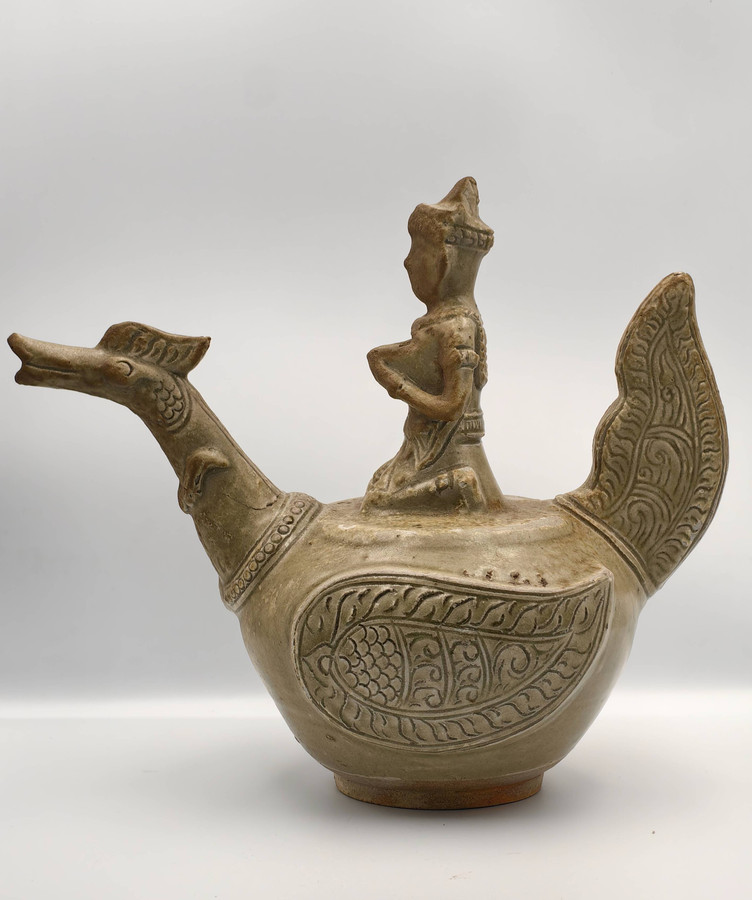
Celadon-Glazed Ewer (in the form of hamsa, with Brahma)
Sawankhalok, Si Satchanalai Kilns, 14th-16th Century
Used to carry oil or other liquid, this exquisite Thai Sawankhalok ewer, masterfully formed as a hamsa with a rider representing Brahma, stands as a testament to the cross-cultural exchanges and religious syncretism that marked Southeast Asia during the 14th to 16th centuries. The melding of the celadon glaze technique with the symbolism of Hindu mythology showcases the rich confluence of trade, artistry, and spirituality of the period. This ewer was most likely used for religious feasts and ceremonies. The celadon glaze covers a form that is deeply rooted in Hindu iconography: the hamsa. A celestial bird in Hindu mythology, the hamsa is often associated with divine knowledge and purity. Riding atop this hamsa is most likely Brahma, the god of creation, emphasizing the significance of this vessel not just as a utilitarian object but also as a spiritually charged emblem. Brahma’s association with the act of creation and his transport by a bird that symbolizes purity and transcendence might hint at the potter's intention to invoke blessings of fertility, abundance, and protection for its user. Provenance and Collector's Note: Private Collection, Cagayan Province. Such ewers are rare, with few known counterparts in major collections worldwide: 1. Worcester Art Museum, MA (US): https://worcester.emuseum.com/objects/8737/bird-with-human-rider-ewer-sawankhalok 2. Victoria & Albert Museum, London: https://collections.vam.ac.uk/item/O251073/kendi-unknown/
Specifications
Dimensions: H: 10 x W: 12 in.
Interested in this piece?
Submit an inquiry and our specialists will contact you with more information, including availability and pricing details.